Tuesday, March 21, 2023

6 Key Advantages of Preschool Education


How a Preschool Education Is Beneficial to Children

While raising children is a fulfilling experience for parents, it can also be overwhelming. There’s so much to consider, including whether sending children to preschool will be helpful. If you’re on the fence about the benefits of preschool for your child, here are six key advantages to consider.

How Preschool Benefits Children


1. Preschool Prepares Children for School

A preschool education prepares students for the more structured kindergarten environment. Even part-time preschool programs can smooth the child's entry into kindergarten.

Preschool exposes children to:

  • Following a routine
  • Using hygienic practices
  • Taking responsibility for personal belongings
  • Practicing interactive skills

These all help children when they start kindergarten.

2. Children Get Accustomed to Rules

Listening skills and the ability to follow instructions take time to develop. In preschool, young children get that practice.

They learn to follow basic instructions, including standing in a line, washing hands before meals, and taking directions from teachers and other trusted adults.

The Westminster School preschool program supports this by having a daily schedule. This ensures children wash their hands before and after every transition and tabletops are cleaned before and after snacks, center time, and lunch.

3. Preschool Promotes Social and Emotional Development

In preschool, a lot of energy is focused on developing social and emotional skills rather than just academics.

Children get an opportunity to do all the following:

  • Learn how to share with their peers
  • Take turns during games and activities
  • Empathize with their friends
  • Exhibit emotions acceptably

These skills help students prepare for kindergarten, elementary school, and beyond. There are also long-term benefits of preschool, including advantages in language, literacy, and math.

At the Westminster School private preschool, the Griffin Academy, children are encouraged to socialize with others and to be well-mannered, kind, and respectful.

4. Preschool Offers Opportunities for Play

Play is the child's work. It’s an integral part of a good preschool education, and it’s a very effective way for young children to learn.

Children gain knowledge as they play with objects and interact with others. For example, children can learn shapes and related concepts, such as putting two squares together to make a rectangle. Role-playing or symbolic play, such as playing house, helps children learn how to communicate their ideas and feelings, to resolve conflicts, and to feel competent.

During preschool play, children develop leadership and group skills, build resilience, and learn how to cope with circumstances. Preschool offers children a safe place to explore and to get exposed to different subjects, creative activities, and literature.

Children at Westminster School’s private preschool have time for independent or group play first thing in the morning. They also have recess, which allows for thirty to forty-five minutes of outdoor play, if the weather permits.

5. Preschool Promotes Physical Development

Preschool offers children an environment to develop their motor skills through activities, such as drawing, threading beads, cutting out shapes, and playing outdoors. As children begin holding crayons or colored pencils and zipping up their jackets, their fine motor skills improve as well.

To promote large and small muscle development, the Griffin Academy offers physical education. Children learn control, balance, coordination, and spatial skills, and they also develop the foundation of positive health habits.

6. Preschool Students Develop Language Skills

Children between the ages of three and five expand their vocabulary vastly. Preschool teachers help promote language skills by introducing new words during academics, art, and play sessions. Teachers can urge children to answer in full, descriptive sentences by asking insightful questions. Reading, singing, acting, and role-playing all offer opportunities to develop language.

To promote language development, the Westminster School preschool has:

  • A classroom library
  • A school library
  • Independent library time
  • Daily read-aloud sessions
  • Book fairs

Language arts are part of the curriculum and include listening skill development, pre-reading, and phonics-based reading skills.

Why Choose Westminster School, a Private Preschool in Northern Virginia?

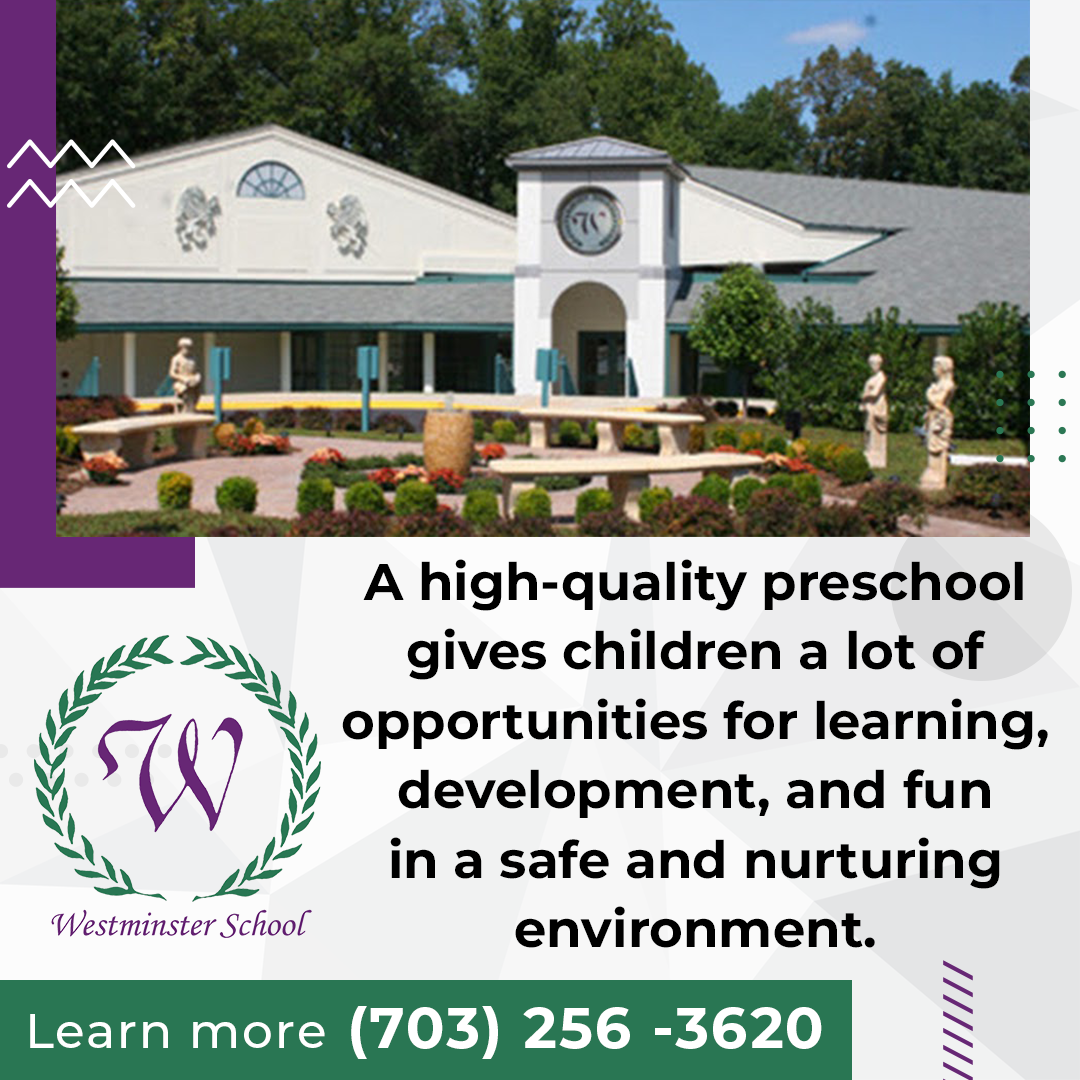
A high-quality preschool gives children endless opportunities for learning, development, and fun in a safe, loving, and nurturing environment.

The Griffin Academy of Westminster School is a private preschool located in Northern Virginia. The program focuses on a balance between play and structured learning opportunities, providing the perfect environment for children to begin early education.

The Griffin Academy has a team of well-qualified teachers, a student-teacher ratio that never exceeds 10:1 per class, and an exceptional curriculum. This ensures every child enjoys well-rounded intellectual, social, emotional, and physical development.

Parents looking for a private preschool in Northern Virginia can call (703) 256-3620 to schedule a tour and to learn more about the Griffin Academy at Westminster School.

Tuesday, October 4, 2022

The Value of Collaboration in Education

 One of the many reasons parents choose Westminster School is because the program is founded on rigorous academic standards, as well as an atmosphere that promotes respect, integrity, kindness, and excellence. Because of this focus, the school takes a collaborative and holistic approach. They seek to shape not just what students learn but how they learn. 

Why Collaborative Learning Is So Valuable

An abundance of research demonstrates students benefit from active, collective, and contextual educational experiences. Student-owned collaborative learning leads to higher-level cognitive skills, improved communication, and more effective problem-solving skills. Collaboration involves cooperation. This approach develops executive functions that help students plan and focus. It also improves regulation patterns, such as reflecting on one’s own actions. 

Studies show active or collaborative educational methods result in both statistically significant and measurable gains in student learning and retention compared to those associated with more traditional and lecture-based instructional methods.

Top Benefits of Collaboration in Education

Westminster School has placed a high value on collaboration since the private school began in 1962. Since that time, generations of students have benefitted from its classical education and collaborative educational environment. 

Here are the top advantages of collaborative learning. 

Students Learn Diversity Leads to Better Solutions 

When students work in groups, they learn the value of their unique skills and the unique skills of others, and they discover how all are beneficial in solving problems. They learn they can reach better solutions more efficiently using diverse skills than individual skills alone.

Collaboration Leads to Innovation

Collaboration leads to innovation by creating joint ownership, promoting the adoption of diverse practices and ideas, unlocking cognitive pathways, and spreading the risk over a greater number of participants.

Collaboration Helps Remove Biases 

Every person is exposed to biases daily. Working in a diverse group helps break down common misbeliefs. Having multiple diverse people working on the same project helps make it easier to identify and dispel those incorrect assumptions.

Collaboration Demonstrates the Need for a Community 

Rather than letting a complex problem hinder learning advancement, students discover an effective team can conquer difficult challenges successfully when they work together.

Collaborative Work Results in Higher-Caliber Results

When students work in a group environment, they use all their skills in problem-solving. This results in increased learning gains and better solutions. This environment encourages better communication, leadership, and preparation.

Collaboration Is in Demand

While many professionals lean toward increasingly siloed work environments, employees who thrive in a collaborative environment are highly sought after for high-paying and in-demand jobs. 

Collaboration Helps Promote Emotional Maturity

Working as a team helps promote emotional maturity by building empathy, learning to appreciate different perspectives, developing conflict resolution skills, and learning to listen actively. 

Learning Collaboratively Removes Barriers

In a collaborative environment, students learn they do not have to be the best at everything. Rather, they can utilize their strengths while learning from others and bolstering other areas of their learning. It demonstrates there is always more to learn and that individuals always have something to contribute to the learning process, no matter the age or stage. 

Westminster School | Private School 

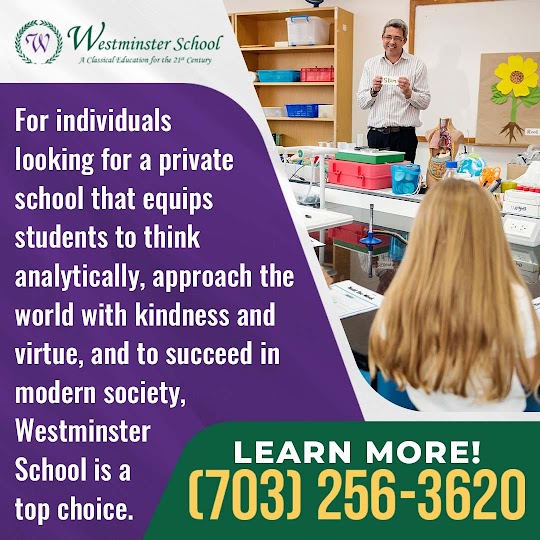
For individuals looking for a private school that equips students to think analytically, approach the world with kindness and virtue, and succeed in modern society, Westminster School is a top choice in Annandale, VA. The Westminster program is founded on a classical curriculum; rigorous academic standards; and an atmosphere that promotes respect, integrity, kindness, and excellence.

For more information about the school, they can be reached by email at admissions@westminsterschool.com or by phone at (703) 256-3620.

Westminster School

3819 Gallows Rd

Annandale, VA 22003

(703) 256-3620

Tuesday, September 13, 2022

Westminster School Shares the Top Benefits of a Classical Education

 What Are the Benefits of a Classical Education? 

When most people look for a private school in Virginia and discover Westminster School, one of the first things they want to know is how a school that provides a classical education differs from a traditional public, charter, or private school. It is a great question because there are foundational differences. Simply put, traditional education stresses what to learn; classical education teaches students how to learn. This distinction means a classical education offers specific advantages over a traditional or progressive education.

Classical Education Has Proven Successful

The classical education methodology has been around for centuries, and it has produced a countless number of the world’s greatest leaders, inventors, scientists, writers, philosophers, theologians, physicians, lawyers, artists, and musicians. 

It Is Academically Rigorous

A private school that implements a classical education follows an academically rigorous methodology based on the trivium. The proven teaching methods correlate with the student’s natural developmental stages (grammar, logic, and rhetoric stages), giving the student a broad liberal arts education.

Students Learn to Learn 

In a private school using the classical education methodology, education begins at the root of knowledge and focuses on inquiry. Rather than learning facts for the sake of learning them, students learn the facts and then decipher how they relate to the rest of the world. As the students progress through the grades, concepts introduced in the lower levels are built upon and reinforced using new skills, such as analytical thinking, essay writing, and public speaking.

Classical Education Builds Autonomy

Because students learn how to extract and to decipher facts, they develop into independent thinkers. Instead of waiting to be given facts to memorize, they receive and evaluate information and then develop their inferences through discussion and reasoning.

Classical Education Celebrates Discovery

Because every concept introduced leads to a deeper understanding, classical education celebrates and taps into the student’s natural desire for discovery. 

Students Learn to Become Great Thinkers

In a classical education, all subjects are taught in relation to each other. This methodology encourages further exploration. The world is presented with its strengths, blemishes, and challenges, and students are taught to receive, to assess, to preserve, and to improve it. 

Classical Private Schools Celebrate Diversity

Whether a private preschool, private kindergarten, or private elementary school, the classical educational approach teaches students to understand and to celebrate culture. Students are encouraged to learn how all cultures contribute to the benefits humanity enjoys.

Classical Education Teaches Wisdom

Until it can be applied, knowledge is only a collection of information. A classical education teaches wisdom, or the application of knowledge, experience, and good judgment. Students are encouraged to consider the impact of the decisions they make.

Students Are Prepared to Succeed Globally as Adults

Learning how languages and cultures were formed and how others from around the world view similar topics helps private school students excel later in life. These skills are beneficial in the development and application of technologies, conflict resolution, and trend recognition. They also help students in their professional lives as they position companies for success.

Students Are Valued and Taught to Value Others

In a classical education, the students are recognized as valuable, capable, and able to participate in the greater private school community. They are taught to collaborate, to think outside of themselves, and to recognize that everyone has strengths and challenges. This allows them to assist others and to receive assistance graciously. These collaborations lead to phenomenal growth and discovery.

Westminster School | Private School 

For individuals looking for a private school that equips students to think analytically, to approach the world with kindness and virtue, and to succeed in modern society, Westminster School is a top choice. 

Westminster School is dedicated to providing a superior elementary and middle school education. The fundamental goals for each child are a disciplined and well-informed mind, strength of character, a dedication to learning, generosity of spirit, and joy in the possibilities of life. The Westminster program is founded on a traditional curriculum; rigorous academic standards; and an atmosphere that promotes respect, integrity, kindness, and a sense of excellence. Westminster’s academic program provides thorough training in foundational subjects within a broad humanities curriculum.

For more information about the school, they can be reached by email at admissions@westminsterschool.com or by phone at (703) 256-3620.

Westminster School

3819 Gallows Rd

Annandale, VA 22003

(703) 256-3620

Friday, July 22, 2022

Westminster School Explains the Importance of the Great Outdoors for Children


The Importance of the Great Outdoors for Children

As children spend increasingly less time enjoying nature and playing outdoors, an array of problems are arising in their development. From obesity to ADHD to depression, children in the United States have been struggling with major health challenges. For many, this is due to screen addictions and other unnatural shifts in lifestyles. Westminster School, a private school in Annandale, Virginia, discusses the importance of the outdoors for children and how its students immersed themselves in nature and outdoor activities this spring. 

The Benefits of Being Outdoors

  1. Physical fitness: The outdoors benefits a child’s body by providing adequate sources of vitamin D, improving distance vision, and offering opportunities to become physically fit. Activities like hiking; biking; or playing sports, such as football or running, keep children physically active and fit. This keeps diseases, such as diabetes, obesity, and heart disease, at bay. 

  1. Mental fitness: Recent studies show children and adults truly need to spend time in nature. Exposure to nature helps improve concentration and reduces anxiety. The unstructured play in nature fosters imagination and creativity. It also activates the senses of smell, sight, touch, and hearing. Overall, environment-based education is known to increase students’ performance on critical thinking skills tests.

    Moreover, as per the attention restoration theory, natural environments help people practice the attention called soft fascination. This practice increases pleasure and reduces the feeling of fatigue caused by urban environments. 
  1. Emotional wellness: Natural environments provide restful experiences and reduce the need for directed attention. This helps reduce stress levels, which fall within minutes of being in green spaces. A lot of unstructured time in nature allows children to escape from the hurried lifestyle that dominates the world today. Besides reducing anxiety and depression, being connected with nature also encourages more prosocial and empathetic behavior among children, according to research.

Westminster School Celebrates the Great Outdoors with Its Students

Westminster School celebrated this spring by arranging several outdoor activities for students across different grades. Not only were these activities about enjoying nature and playing outdoors, but they were also about fostering collaboration and sportsmanship.

A Visit to Camp Crowell

On April 18, the Griffin athletes spent the day at Crowell, a national Girl Scout camp in Oakton, Virginia. This was through the Inner Quest program. Despite the snow and sleet in the morning and rain, later on, the students were determined to stay outside as long as they could. After an indoor lunch, they played a few more cooperative games, reinforcing the day’s theme of teamwork.

On April 25, the fifth-graders enjoyed better weather and more activities at Camp Crowell, such as playing the "spotter” and the "flying squirrel."

The sixth-graders camped on May 2, engaged in cooperative activities, and enjoyed the zip line.

Ben from the fifth grade said, “It was so much fun to play with my friends at the camp. I am excited about the next camping trip!”

New Horizons Overnight Camp

On May 6, the eighth-graders journeyed to New Horizons for an overnight camping trip. After dinner in the New Horizons summer campground, the campers enjoyed active games, such as spider ball. In classic campout style, this was followed by delicious s'mores. Before returning to the city on Saturday morning, the eighth-graders took in the fresh air, hiking along Fridley Gap Trail.

Canoeing at Beaverdam Reservoir

On a sunny Monday, May 9, the seventh-graders completed their Inner Quest field trip with a visit to Beaverdam Reservoir. With spring in full bloom, the students soaked up the beauty surrounding them while they learned to canoe and to work together as a team.

Susan from seventh grade was ecstatic, “I can’t believe we managed to canoe across the reservoir. And it was so beautiful. The flowers. The water. The lovely weather.”

Capital Athletic Conference Track

After the single-grade outings, the Griffins worked together at the Capital Athletic Conference track meet on May 11 at Langley School. The Griffins brought home the second-place banner from a field that included six schools.

Charlie from the Griffins said, “We came second. It was a tough competition but we did it! I’m so excited to tell my parents and friends about this.”

Westminster School is proud of its students’ stellar athletic performance and participation. With the help of the school’s athletic director and PE teachers, the students not only enjoyed but succeeded in these athletic programs. These are an integral part of Westminster School’s well-rounded and complete educational experience

Why Westminster School?

Established in 1962, Westminster School is a private school that follows the traditional and time-tested classical education for the forward-looking 21st century. The school adheres to high standards of education that set it apart from other public and private schools. Besides building a well-informed mind, strength of character, dedication to learning, generosity of spirit, and joy in the possibilities of life, the Westminster academic program trains students in basic subjects within a broad humanities curriculum.

The achievements of its graduates, both academic and personal, are a testament to the school’s effective, rich, carefully designed, well-implemented approach to education.